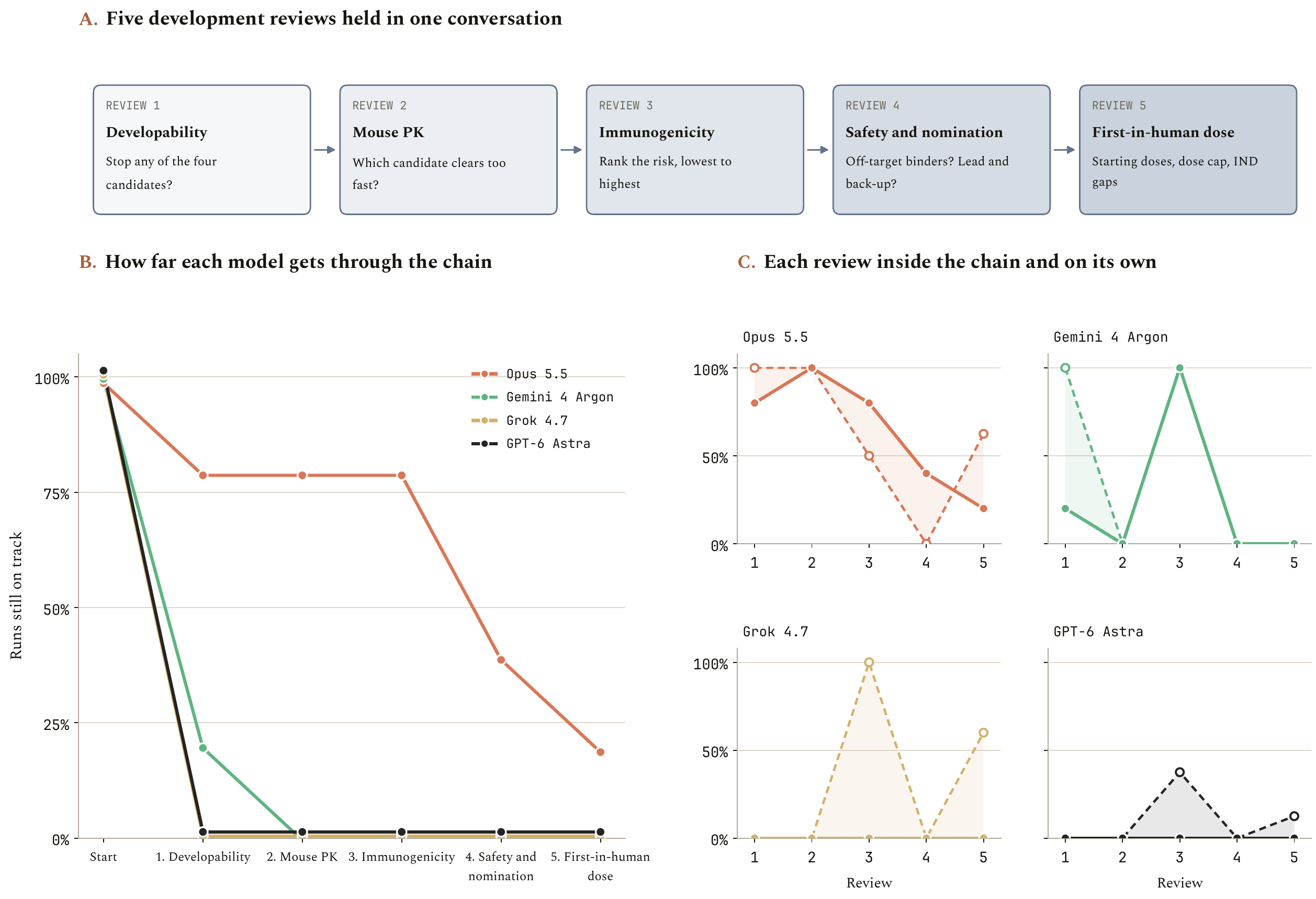
Before an antibody drug reaches its first patient, it has to pass a series of technical decisions: whether the molecule is developable, whether a process change altered it, how fast it clears in animals, whether it provokes anti-drug antibodies, and what starting dose is safe in humans.
Every one of those answers sits in a stack of records: assay tables, batch histories, animal studies, regulatory reviews. Specialists read them, argue over them and make the call. We wanted to know whether today’s AI agents can make those calls too.
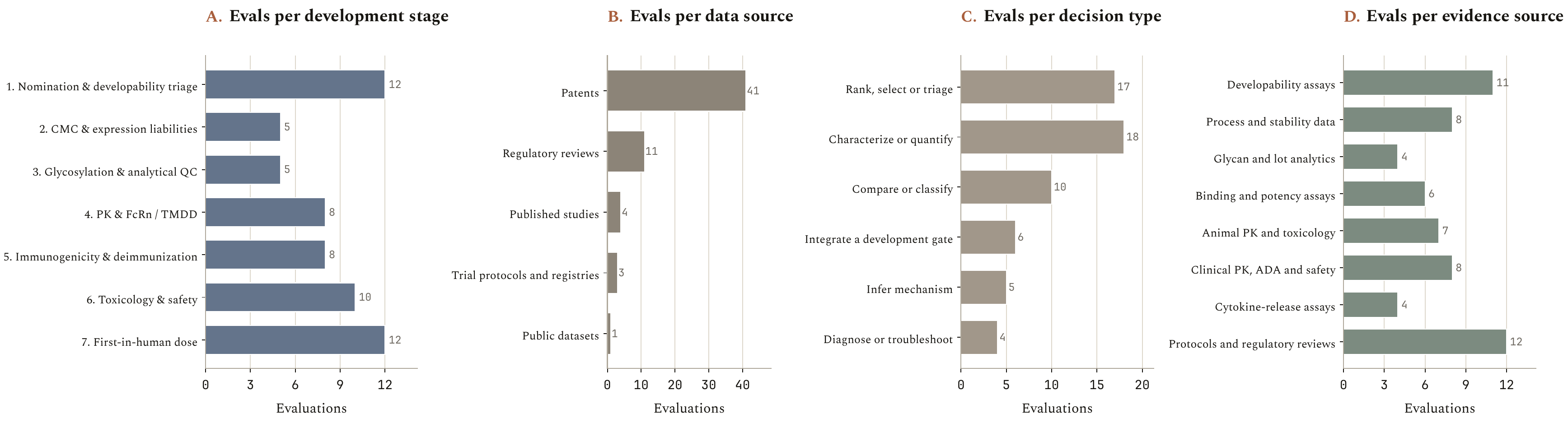
So we built TxBench–Antibody Development: 60 decisions taken from real development programs, covering the seven stages from picking a lead to choosing the first human dose. Each one hands an agent the records and asks for a decision, with the numbers behind it. Code checks every answer against a fixed key, so no model grades another model.
The decisions come from public sources: 41 patents, 11 regulatory reviews, four published studies, three trial protocols or registry entries and one public dataset. We tested 34 setups, each a model paired with a harness (the software the model works inside, such as Claude Code, Codex or Pi). Every setup attempted every decision three times, for 6,110 graded attempts.
These 60 decisions come from public, retrospective records. Benchmark performance is distinct from the judgment of a development team.
At a glance
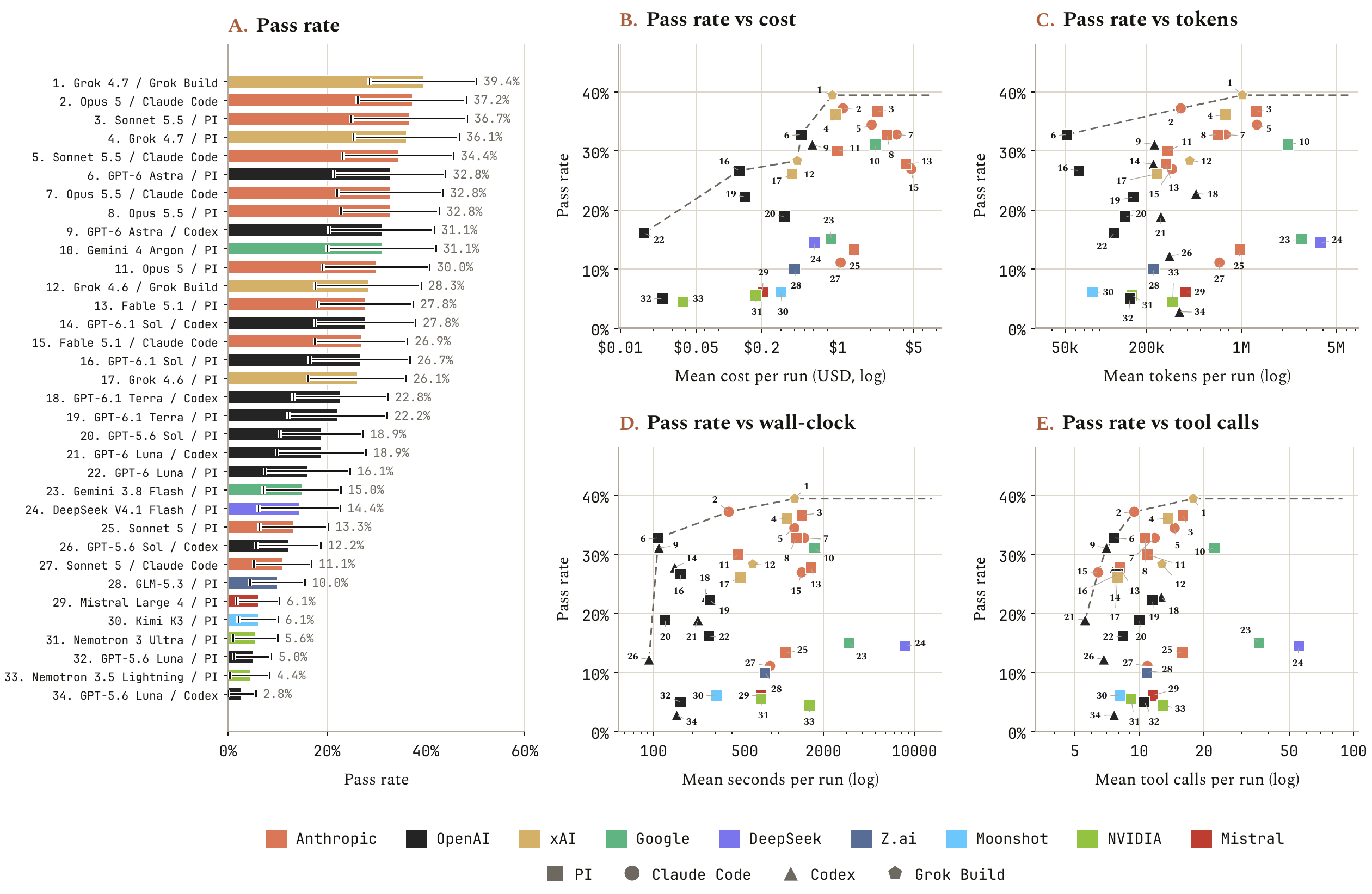
The best setup, Grok 4.7 on Grok Build, got 39.4% right.
The closer a decision got to patients, the harder it was: toxicology and first-dose decisions passed 13% of the time.
On one program taken through five stages in sequence, only Opus 5.5 reached the end, in one of five runs.
The leaderboard
The highest pass rate was 39.4%. Grok 4.7 on Grok Build topped the table, just ahead of Opus 5 on Claude Code (37.2%) and Sonnet 5.5 on Pi (36.7%). At the bottom, GPT-5.6 Luna on Codex got 2.8%.
The low ceiling isn’t because the decisions are impossible. 57 of the 60 were solved by at least one setup.
Cost did not track accuracy. GPT-6 Astra on Pi and Opus 5.5 on Claude Code passed the same share of attempts (32.8%), at $0.46 and $3.47 per attempt.
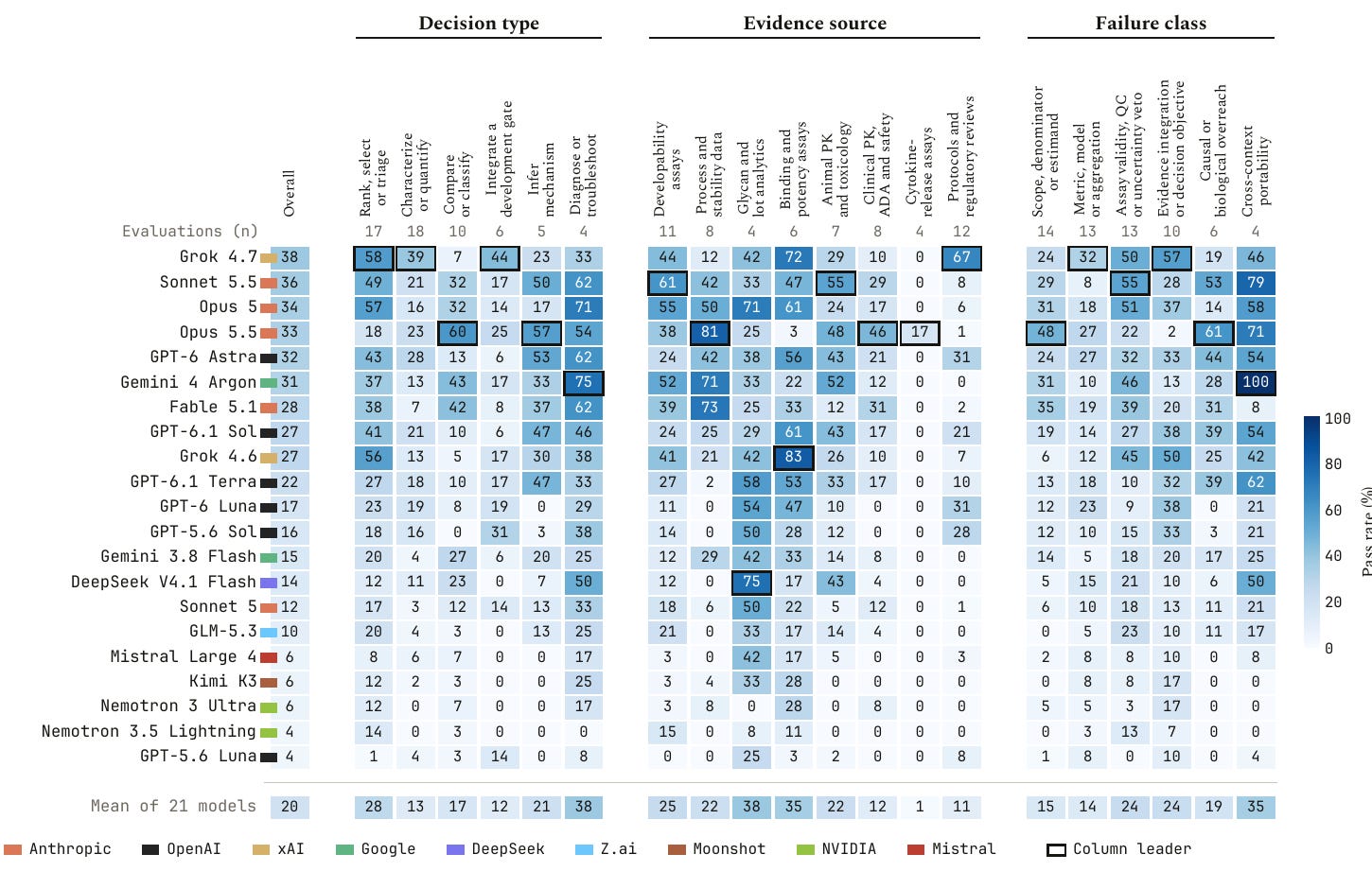
The closer the development stage gets to patients the harder it gets
Toxicology and first-dose decisions passed 13% of the time. Averaged over all setups, that compares with 31% for glycosylation and quality control and 33% for immunogenicity.
No model led every stage. Gemini 4 Argon passed 87% of the manufacturing decisions but none of the first-dose decisions. Grok 4.7 was the reverse: none of the manufacturing decisions, but two thirds of the first-dose decisions. Opus 5.5 was the only model to pass a cytokine-release safety margin, the calculation that keeps a first dose below the level that triggers a dangerous immune reaction.
39.4%: the highest pass rate of any setup
57 of 60: decisions that at least one setup solved
13%: the average pass rate on toxicology and on first-dose decisions

Combining 5 stages of a development program
Development decisions depend on each other, so we also built one program that runs through five stages in sequence, separate from the 60. An agent takes four candidate antibodies through developability, mouse pharmacokinetics, immunogenicity, safety and nomination, and the first human dose, building on its own earlier answers at each step.
Only Opus 5.5 reached the end, in one of five runs. Grok 4.7 and GPT-6 Astra failed the first step in every run, and Gemini 4 Argon got past it once.
In the mouse study, one candidate’s first blood sample was unusually low. Opus 5.5 read it as a dosing artifact rather than fast clearance in 13 of 13 runs; the other models did so in 0 of 36. This let Opus 5.5 pass the safety and nomination step in two runs, a step no model passed when it was given on its own.